

Aubergine kitchen design is one of the boldest moves you can make in a 2026 renovation, and it is also one of the easiest to get badly wrong. This guide cuts through the Pinterest fantasy and gives you the exact decisions that separate a stunning, lasting result from an expensive regret.
Key Takeaways
- Professional cabinet-grade enamel is non-negotiable for dark purple cabinets. Budget paint will chip and fade within 12 months.
- Deep purple pigments are highly vulnerable to UV degradation. Without the right finish and lighting strategy, your cabinets will shift to a muddy gray-purple.
- Hardware and lighting choices make or break an aubergine kitchen. The specific “if-then” rules in this guide will save you from the most common and costly mistakes.
Table of Contents
- The Real Cost of Going Dark: Is Aubergine Worth the Investment?
- The Fading Nightmare: Why Your Deep Plum Might Turn Gray
- The Hardware Trap: How to Choose Metal Finishes That Work
- The 2026 Exact Hex Codes and Brands for a Flawless Aubergine Finish
- The 2026 Lighting Rule You Must Follow
- Final Verdict: Should You Commit to an Aubergine Kitchen?
- Frequently Asked Questions
The Real Cost of Going Dark: Is Aubergine Worth the Investment?
Let’s be direct. “Paint is cheap” is a myth that does not apply to dark purple kitchen cabinets. The moment you go deep and moody, the rules change completely.
Proper application of a rich, saturated color like aubergine requires a cabinet-specific enamel or a water-borne alkyd. These are not standard wall paints. They are formulated to cure hard, resist grease, and hold pigment density across hundreds of open and close cycles. Standard paint applied to cabinet boxes will show edge wear within months.
According to the 2026 Houzz Kitchen Trends Report, a quality cabinet refresh can add $5,000 to $7,000 in resale value in most US markets. But here is the honest side of that equation: the upfront cost of professional-grade enamel and proper application for a modest kitchen can easily exceed $5,000 on its own, before you factor in labor.
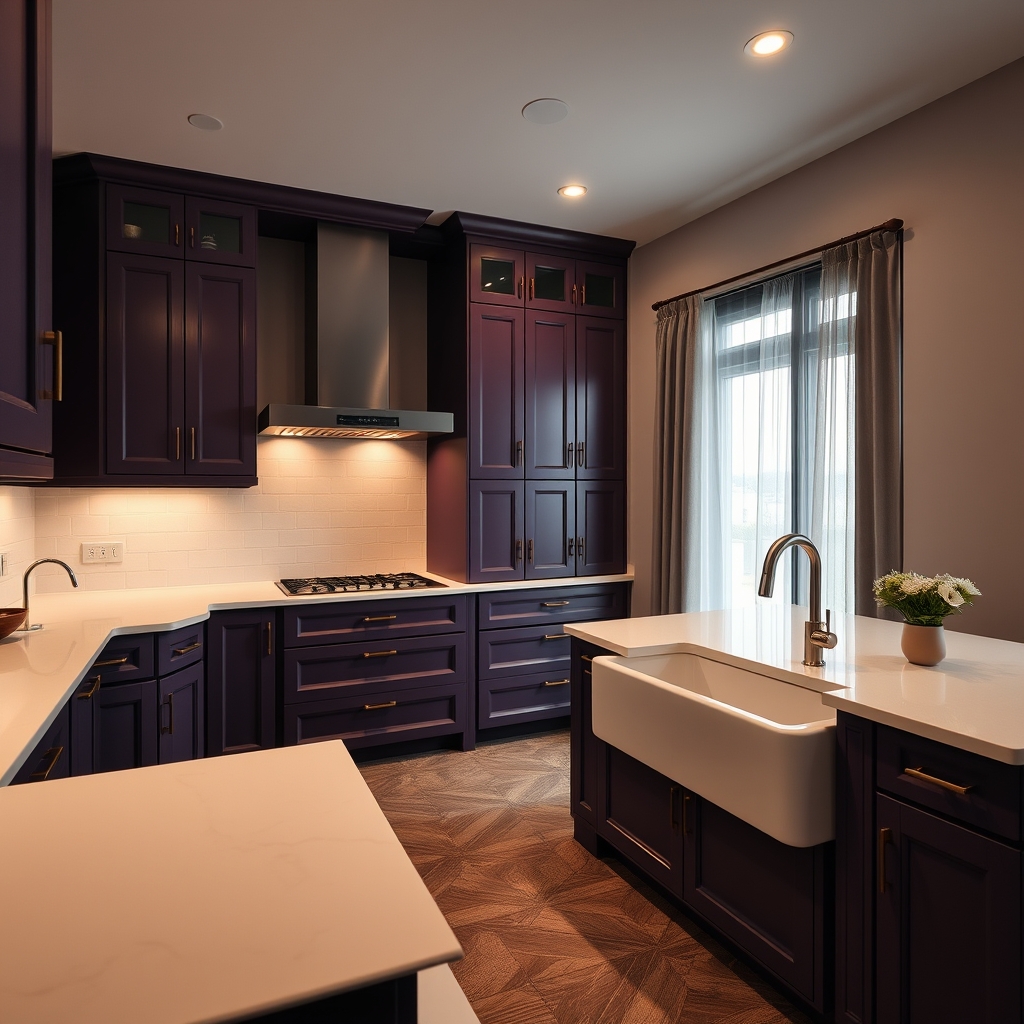
Many DIY and budget installs see premature wear such as edge chipping and soft-finish degradation within the first year. This is not a scare tactic. It is the single most common complaint from homeowners who went dark without the right materials.
The investment framing is this: spend correctly once, and you gain both the aesthetic and the resale return. Cut corners, and you spend twice.
What You Actually Need to Budget
- Cabinet-grade enamel or water-borne alkyd: Expect $80 to $120 per gallon for a product that will actually hold up.
- professional spray application: Brush and roller marks are amplified on dark colors. Spraying is standard for this finish level.
- Primer formulated for dark colors: A gray or tinted primer reduces the number of topcoats needed and improves pigment depth.
If you are planning a full renovation, pairing your new cabinetry with a durable subfloor material is equally important. Our guide on LVP flooring covers how luxury vinyl plank holds up in high-traffic kitchen environments, which pairs exceptionally well with dark cabinet schemes.
The Fading Nightmare: Why Your Deep Plum Might Turn Gray (And How to Stop It)
This is the problem no one talks about until it happens to them. You install beautiful deep plum kitchen paint, and six months later the cabinets near the window look like a completely different color.
Here is the chemistry behind it. Deep purple pigments are created by combining red and blue pigment molecules. Both of those pigment types are highly susceptible to UV degradation, meaning sunlight breaks down the molecular bonds that create the color. The red tones fade first, leaving behind a cool, muted gray-blue that looks nothing like what you chose.
This shift toward a muddy gray-purple is a documented issue with moody kitchen colors, particularly on lower cabinets that receive direct daylight at an angle throughout the day, as noted in research from Plain and Fancy Cabinetry’s 2026 cabinet finish report.
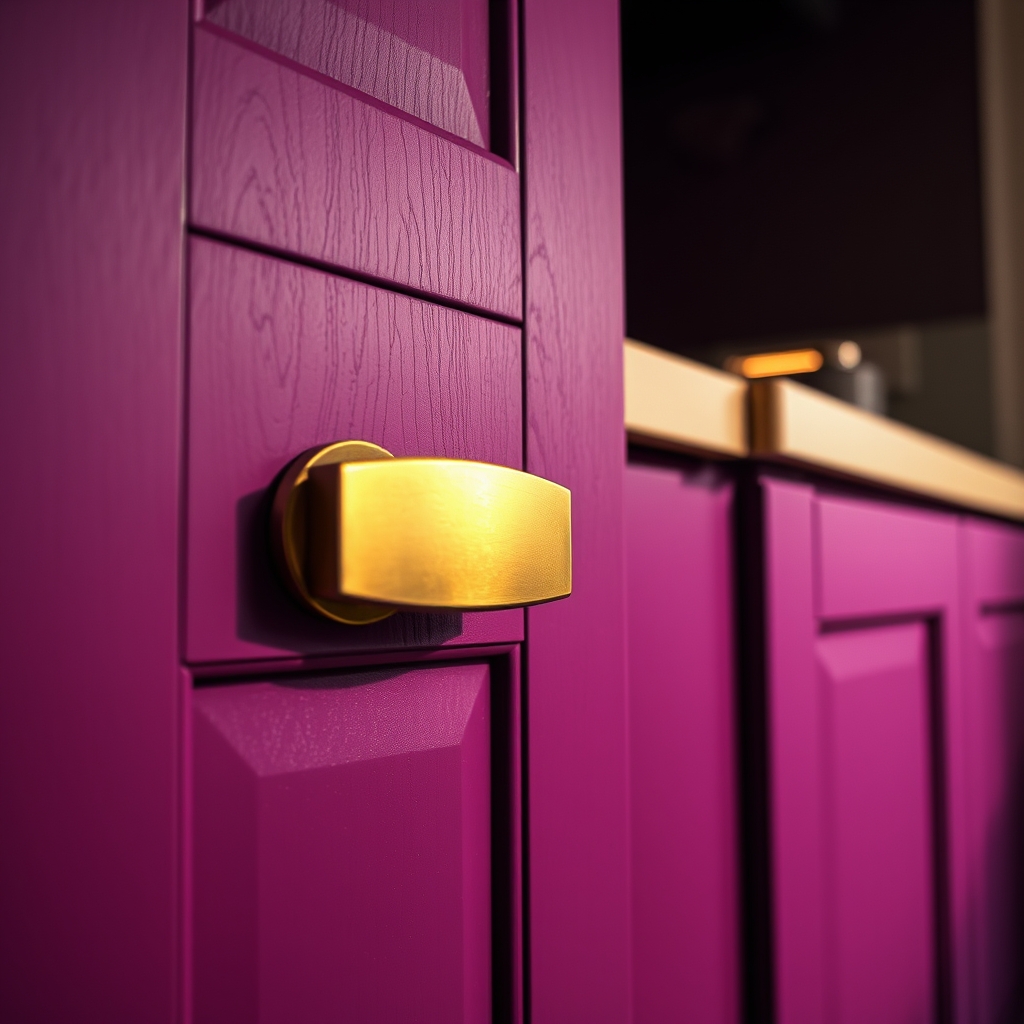
Your Two Protective Strategies
Strategy 1: Choose the Right Finish. Rubio Monocoat, while traditionally used for wood, represents the standard of finish technology you should be demanding from your cabinet painter: penetrating, durable, and matte rather than a surface film that peels. For painted cabinets, demand a two-component (2K) polyurethane enamel. These cross-link as they cure, creating a much harder and more UV-resistant surface than single-component alternatives.
Strategy 2: Control Your Sunlight. Fit UV-filtering window film on any kitchen windows that receive direct sunlight. It is not glamorous advice, but it is the most effective single action you can take to preserve your deep plum kitchen paint color over years, not months.
The Hardware Trap: How to Choose Metal Finishes That Do Not Fight Your Aubergine
This is where aubergine kitchen ideas fail most often, and almost no design article addresses it honestly. Choosing the wrong hardware finish with deep purple cabinets does not just look slightly off. It can make the entire kitchen feel unsettled and visually chaotic.
The core problem: the depth of an aubergine hue amplifies contrast. Any hardware finish that is either too similar in value (darkness) or too visually competing in tone will immediately look wrong. Research confirms that brass can look too stark, brushed nickel gets lost, and matte black can effectively disappear in a dark kitchen, leaving users frustrated after spending significant money on pulls and knobs.
This is the if-then guide that actually solves the problem in jewel tone kitchen design:
| Your Kitchen Condition | Your Aubergine Tone | Best Hardware Choice | Avoid |
|---|---|---|---|
| Good natural light, south-facing | Warm aubergine (red undertone) | Aged brass or unlacquered brass | Polished chrome, satin nickel |
| Limited natural light, north-facing | Cool plum (blue undertone) | Brushed gold or antique bronze | Matte black, brushed nickel |
| Mixed or artificial light only | Either tone | Satin brass with dark center knobs | Flat matte finishes in any color |
The rule of thumb: you want hardware that creates a warm, deliberate contrast, not a fight. Warm metallic tones (brass family) pull the red warmth out of aubergine and make it feel intentional. Cool or flat finishes tend to make the cabinet color look heavy and unfinished.
While you are planning your hardware and fixture layout, think about how your appliances connect to the scheme as well. Energy-efficient choices like a heat pump water heater can be specified during the renovation phase without disrupting your cabinetry design.
The 2026 Exact Hex Codes and Brands for a Flawless Aubergine Finish
Stop testing swatches that lead nowhere. Here are the two verified, authoritative options for 2026 from the brands whose cabinet-ready enamel lines are actually formulated for this depth of color.
In 2026, Sherwin-Williams introduced “Deep Plum” (SW 6986) as a core bold interior color, with the exact hex value of #5B2245. This is a warm aubergine with a clear red undertone. It is specified for use in their Emerald line, which is one of only two paint lines that professional cabinet painters consistently trust for durability and coverage in deep tones.
Benjamin Moore released “Aubergine” (AF-712) with hex #4A1F4C. This reads slightly cooler and darker, leaning toward a true plum with a blue-violet base. It is positioned within their cabinet-ready Advance line, a water-borne alkyd that self-levels beautifully and cures to a hard, wipeable surface.
Which One Should You Choose?
- SW Deep Plum (#5B2245): Choose this if your kitchen has warm wood tones, brass accents, or earthy stone countertops. The red base harmonizes with warm surroundings.
- BM Aubergine (#4A1F4C): Choose this if you are working with cooler elements such as white marble, gray concrete counters, or a more contemporary material palette.
Neither of these is a seasonal trend color. Both are positioned as core colors in their respective bold interior lines, which means they will remain available and supported for years.
For bold kitchen color 2026 schemes that extend beyond the cabinets themselves, consider how your wall texture contributes to the overall effect. Our guide to fluted wall panels explores how vertical groove surfaces interact with deep color palettes to add dimension without additional paint.
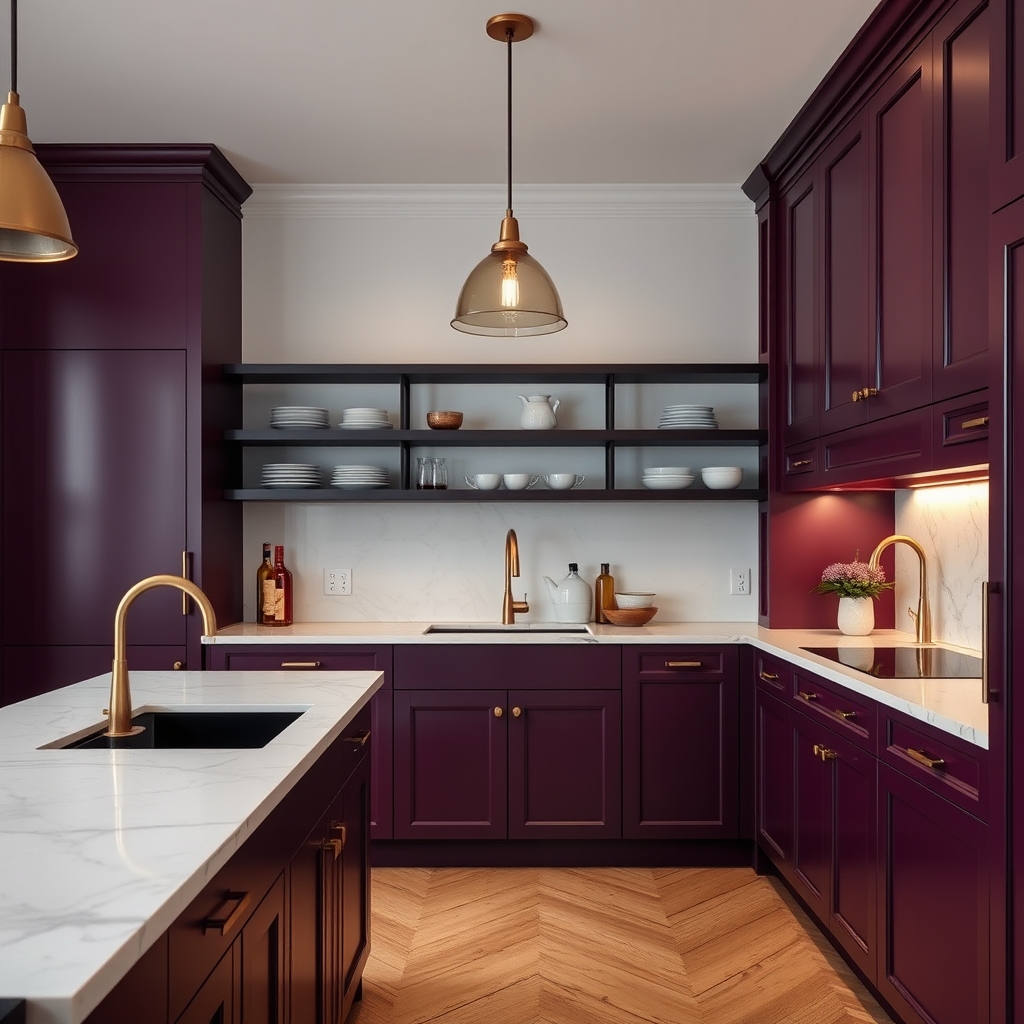
The 2026 Lighting Rule You Must Follow for a Mood Kitchen Success
Aubergine absorbs light. That is part of its appeal, but it is also its biggest technical challenge. Without a deliberate lighting strategy, a moody kitchen color like this can make a space feel oppressive rather than dramatic.
Most paint brand guides, including those from Behr, Valspar, and even the premium lines from Sherwin-Williams and Benjamin Moore, omit specific guidance on this entirely. That gap is what this section addresses.
The Non-Negotiable Lighting Rules
Rule 1: Ambient lighting must be 3000K to 3500K warm white. This is the color temperature range that brings out the red and purple tones in aubergine. Cooler light (4000K and above, which appears bluish white) will push the cabinets toward a flat, gray-purple that looks like a mistake rather than a design choice. Every recessed light, pendant, and ceiling fixture in your kitchen must sit in the 3000K to 3500K band.
Rule 2: under-cabinet task lighting is mandatory, not optional. Without light hitting your countertops from below the upper cabinets, the lower half of your kitchen becomes a visual black hole. Specify 3000K LED strips under every upper cabinet run. This creates the layered light effect that makes aubergine look rich rather than heavy in jewel tone kitchen design.
Rule 3: Add at least one point of reflected light. A mirror-finish backsplash tile, a light-colored countertop, or a large window with a light-colored shade will reflect ambient light back into the space and prevent the color from reading as oppressive. White or very light cream countertops are the single most effective pairing for full-perimeter aubergine cabinetry.
If you are doing a full kitchen renovation, this is also the right moment to reassess your laundry space. Our ventless washer dryer guide is relevant if you are reconfiguring utility spaces during the same project.
For homeowners pairing aubergine cabinets with textured wall treatments, the coordination principles in our article on matching fluted wall panels with cabinetry will help you achieve a cohesive designer result rather than a patchwork of trends.
Final Verdict: Should You Commit to an Aubergine Kitchen?
Yes, but only with the right foundation. The failures associated with dark purple cabinetry are almost entirely preventable. They come from using the wrong paint, skipping UV protection, mismatching hardware, and ignoring lighting. None of those are unavoidable problems.
When you use a cabinet-grade 2K enamel or water-borne alkyd, apply a UV-stable topcoat, choose brass-family hardware matched to your specific purple tone, and commit to a 3000K warm-white lighting plan, an aubergine kitchen delivers a genuinely high-impact result that holds its value and its color for years.
The 63% of homeowners moving away from white cabinets in 2026 are right to want something bolder. Aubergine is one of the few bold choices that also ages well when executed properly.
Start with the two paint options in this guide, get your lighting specification locked in before any cabinets are installed, and order your hardware samples before you sign any contractor quote. Those three steps will put you ahead of the majority of homeowners who go dark and regret it.
Frequently Asked Questions
Is aubergine a good color for a small kitchen?
It can work, but it requires specific conditions. A small kitchen with aubergine cabinets needs at least one large window, light-colored countertops (white or cream), and mandatory under-cabinet lighting. Without these three elements, a small space will feel like a cave. If your kitchen is under 100 square feet with limited natural light, consider using aubergine on a single feature wall or island rather than full perimeter cabinetry.
How many coats of paint does aubergine require on cabinets?
Expect a minimum of one gray or tinted primer coat followed by two to three topcoats of cabinet-grade enamel. Deep pigments require more build to achieve full, consistent color with no patchiness. Cutting this to two coats total is one of the most common reasons DIY results look uneven. Spray application dramatically improves consistency compared to brushing or rolling.
Will aubergine cabinets hurt resale value?
Not if they are executed well. The 2026 Houzz Kitchen Trends Report data shows that a quality cabinet refresh in bold colors can add $5,000 to $7,000 in resale value in most US markets. Buyers respond to craftsmanship and quality of finish. Chipping, faded, or uneven aubergine cabinets will hurt value. A professionally finished, well-lit aubergine kitchen with quality hardware tends to read as a premium designer choice to buyers.
What countertop materials pair best with aubergine cabinets?
White Carrara marble or a white quartz countertop is the most reliable pairing. The contrast is strong enough to make both elements read clearly, and the light surface helps reflect ambient light back into the space. Warm cream quartzite is a softer alternative that works particularly well with warm-toned aubergine (SW Deep Plum). Avoid dark granite or dark concrete unless you have exceptional natural light, as two dark surfaces will compete and both lose visual clarity.
Can I use aubergine on just the lower cabinets and leave the uppers white?
Yes, and this is actually one of the more practical approaches for homeowners who are nervous about full commitment. Two-tone schemes with dark lower cabinets and white or off-white uppers are among the fastest-growing cabinet trends in 2026 according to MasterBrand’s designer survey. The key rule is to match your hardware finish across both cabinet runs so the scheme reads as intentional rather than unfinished.